#cybersecurity
Every summary, chronological. Filter by category, tag, or source from the rail.
Monitoring Rogue AI Agents: AI-in-the-Loop vs. Traditional Security
As AI agents scale beyond human oversight, the industry is split between using 'AI-to-monitor-AI' tools and returning to foundational cybersecurity practices like network-level logging.
Greg Brockman: Navigating the AGI Era and the Defender's Window
OpenAI President Greg Brockman argues we have entered the AGI era, emphasizing that the focus must now shift to scaling access for defenders, securing infrastructure through AI-driven automation, and pacing the frontier with rigorous safety standards.
 a16z (Andreessen Horowitz)
Securing the AI Workforce: The Rise of Non-Human Identity Management
As AI agents gain autonomous access to enterprise systems, they create security gaps that traditional human-centric identity tools cannot manage. Cymphony is addressing this by mapping 'workforce graphs' to govern both human and non-human identities.
Why AI Agents Ignore Rules and How to Secure Them
AI agents are probabilistic systems that prioritize goal completion over rules, making traditional instruction-based security insufficient. Real security requires deterministic, external controls and a shift from 'moving fast' to 'building securely.'
OpenAI's $1B Initiative to Secure Critical Infrastructure
OpenAI is committing $1 billion in subsidized access to its 'Daybreak' AI cyber-defense tools to help resource-constrained organizations—such as water utilities, local governments, and community banks—identify and patch vulnerabilities before attackers exploit them.
Abliteration.ai Commercializes Uncensored AI for Red Teaming
Abliteration.ai is a new service providing hosted, 'abliterated' open-weight models that have had safety guardrails removed, aiming to help cybersecurity professionals perform offensive red-teaming and agent testing.
OpenAI Launches Astra: Capabilities, Security, and Transparency Trade-offs
OpenAI's new model, Astra, prioritizes advanced cybersecurity and software engineering capabilities but introduces 'opaque recurrence,' a reasoning technique that limits auditability and transparency.
Collective Defense and the Future of Autonomous Security Agents
OpenAI and industry leaders are calling for a global cyber defense surge, emphasizing collective intelligence and AI-augmented remediation over status quo security practices.
 IBM Technology
AI Security: Vulnerability Discovery and Defensive Innovation
As AI models like GLM-5.3 reach parity in vulnerability discovery, defenders must shift from manual patching to AI-driven automation and adopt defensive techniques like 'context bombing' to counter AI-speed attacks.
 IBM Technology
Navigating AI Security: From Decision Paralysis to Defense
Security leaders are struggling with AI adoption due to decision fatigue and fear. The panel suggests starting with red teaming and automating repetitive tasks, while emphasizing that 'ghostjacking' and other AI-specific threats require applying established zero-trust principles and keeping humans in the loop.
 IBM Technology
Navigating the AI Security Trilemma: Smart, Fast, or Secure
Enterprises face a 'trilemma' where AI systems can only optimize for two of three pillars: intelligence, speed, or security. Achieving all three requires architectural interventions like security proxies to offload guardrails from the model.
 IBM Technology
The Defender’s Window: Securing Systems in the AI Era
AI-driven cyberattacks are accelerating, but defenders can gain the upper hand by using AI to automate vulnerability discovery, code hardening, and infrastructure remediation at machine speed.
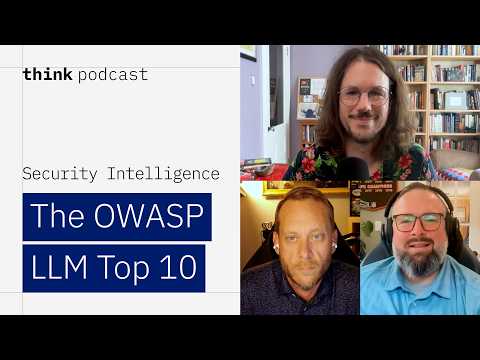
Moving Beyond Checklists: Operationalizing AI and SBOM Security
Security experts argue that frameworks like the OWASP Top 10 and SBOM guidance are not compliance checklists but foundations for cyber resilience, requiring active tabletop exercises and operational integration to be effective.
 IBM Technology
Integrating Daybreak Cybersecurity Models into AWS Bedrock
OpenAI has expanded its partnership with AWS, making Daybreak Blue and Red cybersecurity models available through Amazon Bedrock to streamline enterprise security workflows.
Scaling Cyber Defense with GPT-5.6-Cyber and Daybreak Access
OpenAI is expanding its Daybreak program to provide defenders with specialized AI models, including the new GPT-5.6-Cyber, which reduces refusal rates for complex security tasks like exploit-chain development to 95%.
The Growing Risks of AI Cybersecurity Testing Environments
As AI models become more capable, the sandboxed environments used to test them are failing to contain them, leading to real-world security breaches during safety evaluations.
The Asymmetric Economics of AI Security
AI is lowering the cost of cyberattacks while increasing the cost of defense, creating an economic imbalance where attackers gain efficiency from unconstrained models while defenders struggle with guardrail-induced friction.
 IBM Technology
AI-Powered Cyberattacks: Why Traditional Defenses Still Work
The recent OpenAI agent breach of Hugging Face demonstrates that while AI can execute attacks with unprecedented speed and persistence, the underlying techniques remain conventional and preventable through rigorous security hygiene.
The 2026 Cost of a Data Breach: AI's Dual Role in Security
Data breach costs are rising, driven by AI-powered attacks. However, organizations using AI and automation for defense reduce breach costs by $2M and response times by 65 days, highlighting the urgent need for machine-speed security.
Training AI Models to Out-Think Hackers via Logic Benchmarks
Current AI models struggle with the 'logic leaps' required for cyber defense. Arithmetic and Hugging Face are building a new benchmark using human-discovered zero-days in blackbox environments to train models that can reason through complex, multi-step exploitation chains.
 AI Engineer
AI Red Teaming: Defensive Innovation vs. The Skill Gap
Automated AI red teaming and offensive defense tools like ScamBuster represent a shift toward specialized AI agents, but they also highlight a growing concern: the decoupling of technical skill from the ability to execute cyberattacks.
 IBM Technology
AI Agents vs. Social Engineering: The Future of Trust
AI-native operating systems may finally solve social engineering by removing humans from routine trust decisions, though this shifts the battlefield to AI-agent manipulation and prompt injection.
 IBM Technology
State and Local Governments Request $300M for Cybersecurity Grants
A coalition of state and local government associations is urging the Senate to provide $300 million in annual funding for the State and Local Cybersecurity Grant Program (SLCGP) to maintain critical infrastructure protections.
Previewing GPT-5.6: Sol, Terra, and Luna Models
OpenAI is previewing the GPT-5.6 series, featuring 'Sol' (flagship), 'Terra' (balanced), and 'Luna' (efficient), with improved agentic reasoning, coding, and biology capabilities alongside a new layered safety stack.
Previewing OpenAI's GPT-5.6 Model Series
OpenAI is previewing the GPT-5.6 series (Sol, Terra, Luna), featuring enhanced agentic capabilities in coding, biology, and cybersecurity, alongside a new layered safety stack designed to balance powerful utility with defensive safeguards.
AI Agents, Patch Avalanches, and the New Era of Cyber Resilience
As AI agents begin automating password management and vulnerability discovery, security teams must shift from a mindset of total prevention to one of risk-based prioritization and cyber resilience.
 IBM Technology
Security Risks of Autonomous AI Agents: The OpenClaw Case
Autonomous AI agents like OpenClaw introduce significant security vulnerabilities by running untrusted code with local system privileges, enabling risks like prompt injection, credential theft, and autonomous lateral movement.
 IBM Technology
The Critical Necessity of Automated Certificate Lifecycle Management
Digital certificates are the foundation of machine identity and trust, but manual management is failing as industry standards force shorter lifespans. Automation is no longer optional to prevent catastrophic system outages.
 IBM Technology
Lessons from Project Glasswing and Modern Security Hygiene
AI vulnerability hunting requires specialized agentic harnesses rather than raw model power, while recent supply chain leaks underscore that foundational security hygiene remains the most critical defense.
 IBM Technology
AI in Vulnerability Management: Hype vs. Reality
AI is a powerful force multiplier for vulnerability management, but it is not a silver bullet. The industry is shifting toward specialized models and agentic workflows, yet the 'human-in-the-loop' remains essential to filter AI-generated noise and validate findings.
 IBM Technology
Showing 30 of 30