AI Automation
Workflows that ship. Pipelines, scrapers, agents glued to APIs, and the operational discipline that keeps them running past the demo.
Building AI-Powered Transcription Pipelines with Gemini 3.5
Gemini 3.5 Transcribe enables developers to build high-accuracy, domain-specific transcription pipelines for both live and batch audio without requiring model training.
 Google Cloud Tech
Scaling Autonomous Drone Fleets as Infrastructure
Skydio is shifting drone operations from manual piloting to autonomous, agentic infrastructure by splitting intelligence between edge-based flight safety and cloud-based VLM orchestration.
Building Autonomous Systems for High-Stakes Environments
When AI moves from digital chatbots to physical systems like aircraft and vehicles, failure is not an option. Leaders from Shield AI, Waabi, and GM emphasize that safety, rigorous simulation, and human-centric design are the non-negotiable requirements for real-world deployment.
Solving the Robotics Data Bottleneck via Action-Based Video Search
Robotics training is constrained by a lack of high-quality, naturalistic video data. By shifting from keyword-based scraping to action-based video indexing, developers can filter out noise and access billions of hours of real-world physics and behavior.
Scaling AI Agents: How Ringg Achieves 65% Call Resolution
Ringg uses a multi-model OpenAI orchestration layer to automate customer service, achieving 65% resolution rates and 90% cost reductions by routing tasks to specialized models.
Scaling Regenerative Agriculture with AI-Driven Pasture Management
Labor-intensive rotational grazing is the primary barrier to sustainable livestock farming. By using AI agents to analyze environmental data and automate decision-making for virtual fencing, we can scale pasture-based systems to compete with industrial feedlots.
 AI Engineer
Scaling Multi-Agent Video Analysis at Meta
Meta manages 100M+ videos using a specialized multi-agent pipeline that detects modality misalignment and unoriginal content through domain-specific VLMs, continuous DPO, and aggressive compute optimizations.
Stop Deploying VLMs: Use Vibe Training for Task-Specific Models
Avoid deploying Vision Language Models (VLMs) at runtime due to latency and licensing issues. Instead, use a 'vibe training' pipeline: leverage VLMs to auto-label datasets, use ensemble judges to filter quality, and train small, Apache 2.0-licensed models like RF-DETR for production-grade performance.
Building Institutional Memory with V7's Context Graph
V7 Go uses a structured 'Context Graph' to turn scattered enterprise data into persistent, queryable memory for AI agents, enabling complex, multi-step workflows with high accuracy and auditability.
Automating Bookkeeping: Moving Beyond SaaS Interfaces
Tabby aims to replace traditional accounting software by automating bookkeeping entirely, shifting the focus from manual data entry to real-time, AI-driven financial insights.
Optimizing Inference for Agentic Workflows
Agentic inference requires shifting focus from individual request latency to end-to-end task completion, utilizing prefix caching and agent-aware scheduling to reduce costs and improve performance.
 AI Engineer
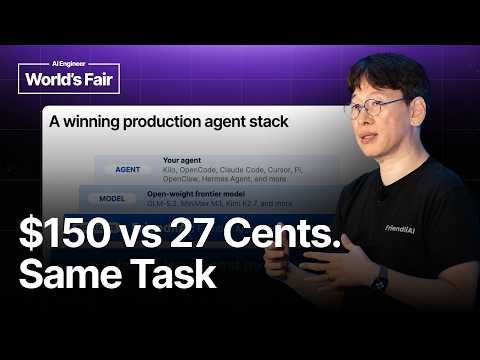
Scaling Small Open Source Models for Production
Small models often outperform frontier models on specific tasks. By moving from top-down routing to a decentralized, queue-based architecture, you can double cluster throughput and drastically reduce latency and costs.
Optimizing Inference Platforms for Trillion-Parameter Workloads
Inference platforms must prioritize KV cache locality and intelligent workload scheduling to manage the high cost of prefill, treating heterogeneous GPU capacity like a game of Tetris to balance real-time agentic traffic with overnight batch processing.
Why LLM Performance Benchmarks Often Lie
Common benchmark harnesses often fail to generate requested load, inflate latency, or use unrealistic settings, leading to misleading results. Reliable benchmarking requires multi-process load generation, client-side observability, and standardized, production-representative workloads.
Breaking Up Walls of Text with AI-Driven Image Retrieval
Improve AI response quality by enriching image metadata with existing human-authored ALT tags, ensuring visual content is semantically searchable and relevant to user queries.
Google's CC: Transitioning AI Agents from Productivity to Household Management
Google is evolving its 'CC' AI agent into a collaborative, family-focused tool that integrates with Gmail and Calendar to automate household logistics, scheduling, and administrative tasks.
Scaling Legal Expertise with Agentic IPO Workflows
Cooley law firm uses an agentic AI system, GO Public, to automate the synthesis of IPO documentation, allowing lawyers to shift focus from manual data processing to high-level strategic judgment.
Monitoring Rogue AI Agents: AI-in-the-Loop vs. Traditional Security
As AI agents scale beyond human oversight, the industry is split between using 'AI-to-monitor-AI' tools and returning to foundational cybersecurity practices like network-level logging.
Building Reliable Multi-Agent Systems with ADK 2.0 Workflows
Stop relying on complex system prompts for agent coordination. Use deterministic workflow primitives—sequential, parallel, and loops—to structure AI behavior and ensure reliability.
Scaling Data Centers Through AI-Driven Demand Response
The AI Energy Management Alliance (AEMA) is leveraging Emerald AI’s software to coordinate data center power usage with grid capacity, potentially unlocking 100 gigawatts of new capacity by shifting compute loads instead of relying on diesel generators.
OpenAI Launches AI-Powered Advertising Platform for ChatGPT
OpenAI is introducing 'Sponsored Agents' and AI-driven campaign management tools, integrating ChatGPT Ads directly into HubSpot and Shopify to streamline ad creation and customer interaction.
Google Home Integrates with Model Context Protocol for AI Control
Google has launched an early access MCP server for Google Home, enabling AI agents like Claude and ChatGPT to securely control smart home devices and query event history via natural language.
Scaling Agreement Data Extraction with Purpose-Built Small Models
Docusign and NVIDIA solved the 'unqueryable agreement' problem by replacing generic LLMs with a 900M-parameter purpose-built vision language model, achieving 20x faster table extraction and significantly lower latency.
Standardizing AI Agent Safety via Third-Party Audits
Artificial Intelligence Underwriting Company (AIUC) is applying a SOC 2-style certification model to AI agents, using a 5,000-test suite to provide enterprises with independent safety audits.
Modernizing Legacy Systems with AI-Assisted Migration
AI accelerates legacy system modernization by automating code discovery, documentation, and translation, allowing teams to preserve critical business logic while reducing technical debt and security risks.
Building Production-Ready AI Agents with Eve
Vercel's Chief of Software, Andrew Qu, explains how moving from complex agent chains to simple, file-system-based architectures doubled their agent performance and led to the creation of the Eve framework.
 AI Engineer
Securing Agentic CLIs: Lessons from PostHog's Wizard
To safely ship agentic tools that execute code, separate deterministic enforcement from probabilistic judgment. Treat your own supply chain as a potential attack vector and assume that while individual components may be innocent, their composition can create vulnerabilities.
Building Reliable AI Agents with Durable Execution
To move agents from demos to production, developers must solve for state, retries, and long-running processes. Restate provides a durable execution layer that turns standard functions into resilient, stateful entities capable of surviving restarts and long-duration waits.
Stress-Testing Morality with Adversarial AI Agents
Loophole uses adversarial LLM agents to translate natural language moral beliefs into formal legal code, identifying contradictions through synthetic case law generation and automated patching.
Harness Engineering: Scaling Production AI Agents
To scale AI agents, developers must separate the model from the 'harness'—the infrastructure for memory, tools, and observability—allowing each component to scale independently rather than bundling everything into a single, monolithic container.
Showing 30 of 555